Showing posts with label Art. Show all posts
Tuesday, November 5, 2013
Thursday, October 17, 2013
“The Harbor At Lorient”
Berthe Morisot (1841-1895)
The Harbor At Lorient
1869
National Gallery Of Art, Washington
Oil On Canvas
16 7/8 Inches By 28 5/16 Inches
________________________________________________
I have never been particularly fond of Berthe Morisot artworks, but this small painting, which I have seen, is exquisite.
The painting was a special favorite of the Mellon family, which donated the canvas—as well as thirteen other Morisot artworks—to the National Gallery Of Art.
Wednesday, July 3, 2013
An Iconic Painting For An Iconic Holiday
James Abbott McNeill Whistler (1834-1903)
Arrangement In Grey And Black No. 1
(“Portrait Of The Artist's Mother”)
1871
Musée d'Orsay, Paris
Oil On Canvas
56 13/16 Inches By 63 7/8 Inches
________________________________________________
The most iconic American painting owned by a non-American museum is Whistler’s famed 1871 portrait of his mother. For the last 122 years, “Whistler’s Mother”, as the painting is commonly known, has been owned by the French government.
“Whistler’s Mother” is now on permanent display at Musée d'Orsay, where in January I saw the painting for the first time. It was hanging alongside a Winslow Homer painting.
Until January, I had had no inkling that the French greatly appreciated Whistler and Homer, and that French art collectors had begun acquiring Whistler and Homer canvases during the artists’ lifetimes.
________________________________________________
Happy Fourth!
Thursday, January 24, 2013
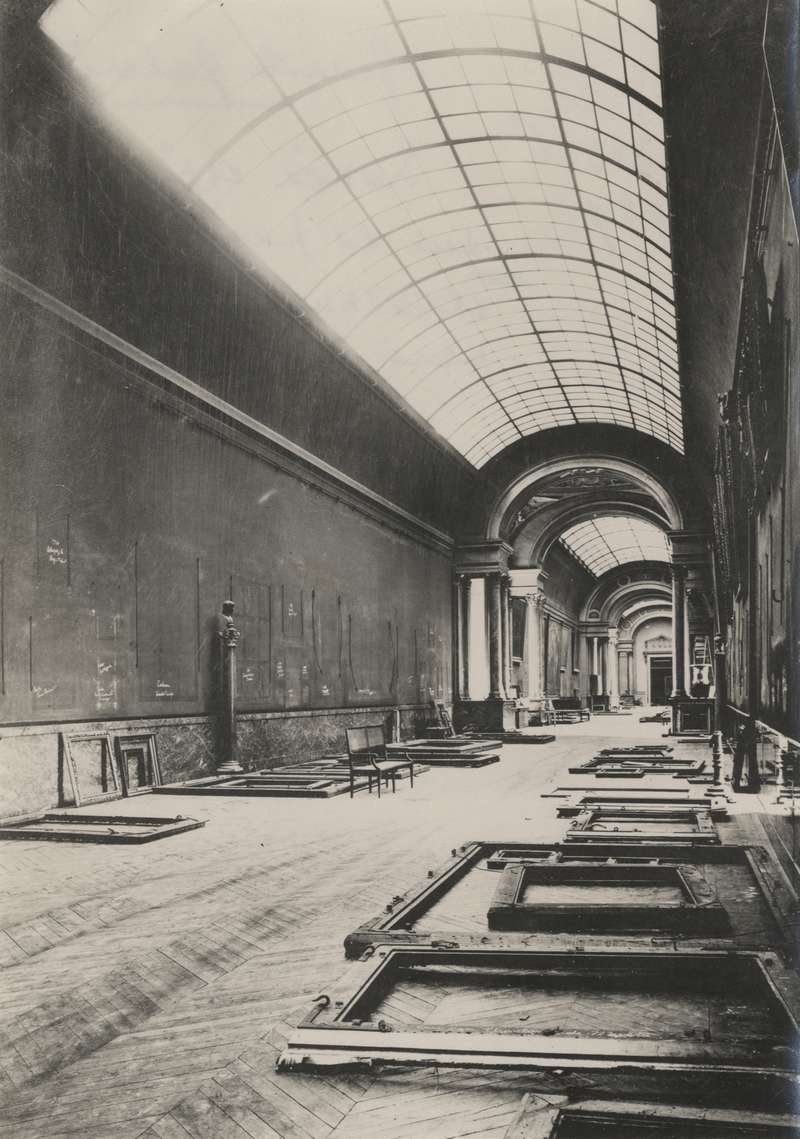
The Grande Galerie 1942
In anticipation of the coming conflagration, French authorities began removing artworks from the Louvre in early 1938, more than eighteen months before the onset of war. By late 1939, six months prior to Germany’s invasion of France, the Louvre was empty—aside from artworks too heavy to transport.
Frames shorn of their canvases remained behind and were left in place in the galleries, all for the purpose of matching artworks and frames once the war had ended.
Eugène Delacroix’s “Liberty Leading The People” was not to be found in The Grande Galerie yesterday; the painting is currently on view at the satellite Louvre in Northern France.
I was not disappointed, given all the giant Jacques-Louis David masterworks on display—but Andrew and Alex immediately noted the Delacroix’s absence and directed inquires to a guard, who said that the painting had been transported to Lens for a few months.
Wednesday, January 16, 2013
Paris
I am becoming more and more excited about our upcoming trip.
I have been to Paris only once, on a whirlwind tour of Europe with my Dad when I was in high school, and we did not spend much time in Paris on that trip (two days and three nights).
On this trip, we have available only eight full days (not including travel days)—but eight days in Paris is better than no days in Paris, and we have prepared an itinerary that interests us and, by and large, is not dependent upon good weather.
On Saturday, we intend to remain out and about all day, weather permitting, in order to ward off fatigue. We intend to explore six churches: Eglise Saint-Gervais-Saint-Protais, Eglise Saint-Louis-en-I’lle, Cathédrale Notre-Dame de Paris, La Sainte-Chapelle, Eglise Saint-Julien-le-Pauvre and Église Saint-Séverin.
On Sunday, we shall spend the morning in Le Marais. We plan to attend Sunday Service at Église Saint-Paul-Saint-Louis (which recently completed a multi-year restoration) and explore the church afterward. We intend to spend the rest of the morning at Musée Cognacq-Jay. After the museum visit, we plan to assemble a lunch at the many excellent Jewish delicatessens and bakeries in Le Marais.
On Sunday afternoon, we have tickets for a performance of Charpentier’s “David et Jonathas” at l'Opéra Comique, which performs at Salle Favart. (Charpentier was for many years Master Of Music at Eglise Saint-Paul-Saint-Louis, the church we will have visited that morning.) After the opera performance, we intend to explore two more churches: Eglise Saint-Eustache and Basilique Notre-Dame-des-Victoires (the latter is Lully’s final resting place; Opera Of The French Baroque is definitely the theme of our day). Our Sunday dinner will be at Chez Chartier—Andrew says everyone must go to Chez Chartier at least once, and I have never been to Chez Chartier.
Monday is built around Les Invalides. We shall first explore two nearby churches: Basilique Saint-Clothilde and Eglise Saint-Francois-Xavier. At Les Invalides, we shall visit the two Invalides churches, Église du Dôme and Cathédrale Saint-Louis des Invalides, and then spend the rest of the day exploring Musée de l'Armée.
Early Tuesday morning, we shall visit two churches, Eglise Saint-Sulpice and Abbaye de Saint-Germain-des-Prés, and afterward spend the rest of the day at Musée d'Orsay. On Tuesday evening, we have tickets for a performance of Mussorgsky’s “Khovanshchina” at L'Opéra Bastille.
Wednesday, Thursday and Friday shall be devoted to Musée du Louvre. According to Andrew and Alex, we should be able to visit approximately forty per cent of the Louvre in three daylong visits. (In 2004, during a spate of very bad weather, Andrew and Alex spent six consecutive days at the Louvre, from open to close, and managed to see approximately eighty per cent of the collection. During those six days, there were portions of the Louvre Andrew and Alex visited over and over and over, and we probably shall do much the same on this trip: lots of backing and filling.)
Andrew and Alex have a system for visiting the Louvre, and we plan to observe the formalities on each of the three days.
We shall have breakfast at our hotel promptly at 7:30 a.m., and leave for the Louvre promptly at 8:15 a.m. On our way, we shall stop at a particular bakery/café Andrew and Alex like, and sit down and have a hot chocolate and a warm chocolate muffin fresh from the oven, both of which apparently are to die for. From the bakery/café, a short walk will place us at the Carrousel du Louvre entrance at 8:50 a.m., and we can get in line at the underground portal and be among the first persons admitted to the museum once visitors are allowed in at 9:00 a.m.
Our first two hours every day will be devoted to painting, an art form that requires maximum attention and concentration. Around 11:30 a.m., after two hours of viewing paintings, we shall take a break and go have an early lunch (to avoid lunchtime crowds) at a very specific restaurant near the Louvre. The restaurant is geared toward Parisian office workers, offers only half-a-dozen fixed menu selections each day and features lightning-quick service, all of which is precisely what we require. For our 11:30 a.m. lunch, we shall order soup and a “plate”.
After our 11:30 a.m. lunch, it will be back to the Louvre for another two hours. For this segment, we shall explore antiquities. After two hours viewing antiquities, we shall head back to the very same restaurant for a second lunch at 2:30 p.m., once again avoiding the lunchtime crowds. For our 2:30 p.m. lunch, we shall order salad and a “plate”.
After our 2:30 p.m. lunch, it will be back to the Louvre for a final two hours. On our last visit, we shall explore sculpture until the museum closes.
Leaving the Louvre, we shall go back to the very same restaurant we have already visited twice and have an early dinner. On our third and final visit to the restaurant, around 5:30 p.m., we shall order a “plate” and dessert.
On each of our three Louvre days, we have tickets for evening orchestra concerts, two at Salle Pleyel and one at Théâtre du Châtelet. Between dinner and concert, we intend to explore Eglise Saint-Germain-l'Auxerrois on one day, Palais-Royal on another and Palais Garnier on yet another.
On our second Saturday in Paris, we intend to visit three churches: L'église Saint-Augustin de Paris, Eglise Saint-Roch and L'église de la Madeleine. After our church visits, we shall spend the rest of the day at Musée des Beaux-Arts de la Ville de Paris, housed at Petit Palais.
In the early evening, we shall return to Cathédrale Notre-Dame de Paris to hear the Saturday evening organ recital, which according to Andrew lasts only 35 minutes. The evening’s recitalist will be an organist and organ professor from Southern Methodist University in Dallas.
After the organ recital, we shall go to the Latin Quarter and have dinner at Alex’s favorite Paris restaurant, Café Procope, an ancient and very historic establishment. In 2004, Andrew and Alex had dinner one evening at Café Procope, and they loved the place, probably more for its history and atmosphere than for its food.
We shall go to Café Procope in order to convene Alex’s birthday dinner. Alex will turn 35 the following day, when we shall be on our way back to Minneapolis and unable to conduct a proper celebration—so we shall be exceedingly pleased to hold Alex’s birthday dinner in Paris.
It should provide a fitting conclusion to our trip.
Sunday, November 18, 2012
Art Goes On During Wartime
Isamu Noguchi (1904-1988)
Ginger Rogers
1942
National Portrait Gallery, Washington
Pink Georgia Marble
Dimensions Unknown
________________________________________________
During the war, Ansel Adams had received permission from the U.S. Government to photograph the Japanese internment camp of Manzanar.
At the very same time, at another Japanese internment camp, the Japanese-American sculptor, Isamu Noguchi, was working as a voluntary internee. Noguchi was the only voluntary internee of the entire war—but his voluntary status quickly became, on government orders, involuntary. He was declared “a suspicious person” and, in late 1942, the government actually attempted to deport him (Noguchi fought the deportation, and prevailed).
While in internment, Noguchi sculpted his famous bust of the film actress, Ginger Rogers, a close personal friend of Noguchi.
Upon receipt of the artwork, Rogers kept the bust on prominent display in her Hollywood home for the rest of her life; after her death, the bust was purchased from the Rogers estate by the National Portrait Gallery. It has been on display in Washington—unless on tour or on loan—ever since.
Noguchi was a close personal friend and admirer of German sculptor Arno Breker. The influence of Breker may be seen in the portrait bust of Rogers. During the Noguchi-Breker friendship, Breker was to sculpt a portrait bust of Noguchi.
Germany’s defeat resulted in the end, for practical purposes, of Breker’s career. Much of Breker’s work was destroyed by Allied occupiers, a stupid and vicious act of vengeance. Ever after, Breker found it near-impossible to reestablish his pre-war reputation and acquire new commissions, even within Germany.
In contrast, Noguchi’s career thrived after the war. He became one of the most prolific and popular sculptors of his time, not just in the U.S. but worldwide.
Anyone who has seen, in person, Noguchi’s portrait bust of Rogers knows it is an inspired work of art, striking and original and true. It instantly captures the viewer’s fascination—and holds it. It always draws a crowd.
Having seen the bust three or four times, I would estimate its height to be 22 inches (the National Portrait Gallery does not offer the bust’s dimensions on the NPG website, nor do other standard and reliable sources).
Not everyone appreciates Noguchi’s bust of Rogers.
Washington Post cultural writer Philip Kennicott called it “hauntingly blank” and “an impassive, dour mask”.
The bust is anything but blank, impassive or dour.
I must assume semi-abstraction has yet to make its way to Kennicott’s world—and that Kennicott would never appreciate Greek Cycladic art, which the Rogers bust greatly resembles.
During visits to Paris in the 1920s and 1930s, Noguchi surely studied Greek Cycladic busts at the Louvre. The influence of Greek Cycladic art is almost as apparent in the Rogers bust as the influence of Breker.
If I were Kennicott, I would have a second look.
The piece is unforgettable.
Saturday, November 17, 2012
Art Goes On During Wartime
Ansel Adams (1902-1984)
The Tetons And The Snake River
1942
Records Of The U.S. National Park Service
________________________________________________
I am not at all a fan of Ansel Adams, but this is undeniably a great photograph.
The photograph was taken at Grand Teton National Park in Wyoming.
It may be my favorite of all Ansel Adams’s works.
Friday, September 28, 2012
The Weisman Art Museum
Minneapolis’s Weisman Art Museum.
The Weisman may be the world’s only museum best-known for what Andrew acidly calls “decorative rust”.
If I were on the Weisman Board Of Trustees, I would instruct legal counsel to file suit against the architect, Frank Gehry, in an effort to recover all costs necessary to remedy permanently the rust problem.
Andrew and I plan to miss—with regrets—the current exhibitions on view at the Weisman: “Ceramics: A Personal View”; and “Contextual Flux”, an exhibition whose title frightens us.
Thursday, September 20, 2012
Tuesday, July 3, 2012
For Independence Day

Edward Hicks (1780-1849)
The Cornell Farm
1848
National Gallery Of Art, Washington
Oil On Canvas
36 3/4 Inches By 49 Inches
________________________________________________
I am not partial to primitive art, but this is a spectacular example, and a most suitable way to mark Independence Day.
The painting depicts the Cornell family farm in Bucks County, Pennsylvania, and is a magnificent—and very beautiful—representation of American industry, thrift and practicality.
Monday, May 14, 2012
Scrupulous Avoidance Of The Words "Excellence" And "Achievement"
On Wednesday, Andrew and I flew to Nashville, Tennessee. The purpose of our trip was to attend my sister’s college graduation.
Much to my surprise, there are at least four daily nonstop flights from Minneapolis to Nashville—I would never have guessed, before researching our trip, that there were ANY nonstop flights between the Twin Cities and Nashville; I had expected we would be required to route ourselves through Chicago—and Andrew and I were able to book the most convenient nonstop flight of the day, the late-morning flight. It took us little more than two hours to get to Nashville.
Early Wednesday afternoon, we met up at the Nashville airport with my parents (flying in from Oklahoma City) and my brother (flying in from Dallas)—and we all spent the rest of Wednesday and all day Thursday and Friday with my sister.
The graduation events and ceremonies were not inherently interesting—they never are—but we made it through two-and-a-half days without significant pain.
My sister is happy to leave Vanderbilt, a school she has never liked, and she is happy to leave Nashville, a city she has never liked.
My sister is nowise unhappy or dissatisfied with the last four years. She achieved her objectives—a Baccalaureate from a “name” school, lots of like-minded friends, and grades and test scores high enough to get her into one of the nation’s finest business schools—but now she is ready to move on and never look back, leaving Vanderbilt far behind her.
I know exactly how she feels.
Until Wednesday, I had never been to Nashville, and neither had Andrew. We did not see much of the city—but what we did manage to see was not particularly impressive. My sister, for four years, has referred to Nashville as “Hicksville”, and my sister is probably not far off the mark.
The nation’s elite institutions of higher learning need to reexamine how they conduct graduation festivities. First, the ceremonies are far too long—are two full days of activities genuinely necessary?—and, second, the ceremonies are monotonous and clichéd, designed to celebrate the institutions and the various dogmas they have embraced rather than the graduates themselves.
I would give Vanderbilt a failing grade on its two days of commencement ceremonies. Everything was poorly organized, hours and hours of dead time were built into the schedule, and the events themselves were alarmingly down-market—as my parents noted, repeatedly, with more than a little displeasure. Everything we saw and experienced suggested a university in total disarray, an institution utterly incapable of presenting a basic annual function at some minimum standard.
Most dismaying of all were the various graduation addresses. Whether by students, faculty or invited guests, the speeches were appalling. It was as if the Vanderbilt administration had gone to considerable lengths to engage the biggest morons they could find to speak to the assembled graduates and guests.
The addresses were shameful: uninteresting, unintelligent, unlearned, unreflective, unimaginative, unstylish, revealing not a spark of irony, wit, wisdom or thought. Worst of all, it was positively bizarre—in an educational setting, of all places—to encounter such scrupulous avoidance of the words “excellence” and “achievement”.
The two words, sadly, have been removed from the nation’s lexicon, a face-saving maneuver imposed from necessity once two seedy grifters from Chicago became installed at 1600 Pennsylvania Avenue.
There was virtually no applause after any of the speeches—my parents, like most parents, sat stone-faced through them all—and we thought we heard mild booing as well as mild hissing after several of the addresses.
There most definitely was booing and hissing to be heard after Tom Brokaw’s speech—one wag shouted out, while Brokaw was speaking, “Who was the ghost writer for your book, Brokaw, you hack?”, which elicited more than a little laughter—and there most definitely was booing and hissing to be heard after the speech of Vanderbilt’s Chancellor. In both cases, the booing and hissing were well-deserved.
If I were on the Board Of Trustees of Vanderbilt University, I would vote immediately to discharge Vanderbilt’s Chancellor, Nicholas Zeppos. Based upon his speech, and based upon our experiences at the institution he leads, Zeppos is little more than a comedy figure, with far more in common with the Marx Brothers than just his last name.
On Saturday morning, graduation events over, we all went our separate ways. In the late morning, my brother flew back to Dallas and my parents flew back to Oklahoma City, with my sister and her things in tow. (This coming Friday, my sister will fly to Minneapolis in order to spend ten days with Andrew and me. She will be our first houseguest in our new house, and Andrew and I are busy trying to figure out how to entertain her for ten days.)
Very early Saturday morning, instead of returning to the Twin Cities, Andrew and I flew to Kansas City.
We had to rise at 3:00 a.m. in order to be at the Nashville airport at 4:30 a.m. for a 5:30 a.m. flight to Atlanta. In Atlanta, we changed aircraft and caught a flight to Kansas City. (There are no nonstop flights between Nashville and Kansas City; the most advantageous routing for us, time-wise and duration-wise, was through out-of-the-way Atlanta.)
Andrew and I had wanted to visit Kansas City in order to explore the Nelson-Atkins Museum Of Art. I had visited the Nelson-Atkins before—I had been fourteen years old at the time—but Andrew had never visited the Nelson-Atkins. Both of us wanted to spend some serious time at one of the world’s very greatest art museums.
We spent all day Saturday and all afternoon Sunday at the museum.
We enjoyed the Nelson-Atkins immensely. It is a spectacular museum with a spectacular collection.
The artworks at the Nelson-Atkins are extremely well-presented. In fact, the art presentation at the Nelson-Atkins is among the finest I have seen at any museum in the United States or Western Europe.
The Nelson-Atkins has an unusual history.
The institution came about simply because two large private pools of money had been set aside early in the 20th Century to erect a building and to acquire an art collection at such time as city fathers decided that Kansas City needed an art museum. There were no founding collections; no major donors presented the institution with existing art collections that could be used as a basis for building a large and comprehensive permanent collection.
The museum as an institution was not founded until the very end of the 1920s. Construction of the first building did not begin until 1930. The museum did not open until 1933.
Because of The Stock Market Crash Of 1929 and the ensuing worldwide Depression, the late 1920s and the early 1930s, seemingly, were the worst possible times in which to found a museum, to erect a building, and to acquire an art collection from scratch.
The Nelson-Atkins, however, enjoyed a remarkable stroke of luck. It was founded upon two great fortunes—and both fortunes, fortuitously, had cashed out of the stock market prior to its 1929 collapse and had shifted assets into U.S. Government Bonds, the only financial instruments in the world that rose in value throughout The Great Depression.
The result was that the Nelson-Atkins was flush with cash precisely at the time world art markets collapsed. (In 1929, world art markets crashed immediately after world stock markets crashed).
For the next fifteen years, the Nelson-Atkins went on a buying spree; it was the largest acquirer of art in the world during this period—and at fire-sale prices. Almost every significant Old Master painting offered for sale in the U.S. between 1930 and 1945 was acquired by the Nelson-Atkins; almost every significant Old Master painting offered for sale in Europe between 1930 and 1939 was acquired by the Nelson-Atkins. (The Wadsworth Atheneum in Hartford, Connecticut, was the only other museum in the world actively buying Old Master paintings during this period of economic distress—but the Wadsworth Atheneum lacked the vast financial resources of the Nelson-Atkins.)
The result of the buying frenzy: the Nelson-Atkins—an institution that owned not a single painting (or other work of art) on January 1, 1930—today has the finest collection of European paintings in the nation’s heartland.
Andrew and I viewed the European and American painting collections at the Nelson-Atkins twice, one viewing on Saturday and a second viewing on Sunday. We made it through as much of the rest of the collection as time allowed.
The Nelson-Atkins made our visit to Kansas City worthwhile.
On Saturday night, we attended a performance of Kansas City Ballet at the new Kauffman Center For The Performing Arts in downtown Kansas City.
I had seen Kansas City Ballet on a single previous occasion—I had seen Kansas City Ballet dance “The Nutcracker” when I was eight years old—but Andrew had never seen a performance by Kansas City Ballet. We enjoyed Saturday night’s performance very much; the program was a good one.
Our return to Minneapolis early Sunday evening was a snap. There are numerous daily nonstop flights between Kansas City and Minneapolis, and flight time is only one hour and twenty minutes between the two cities.
Andrew and I were on a plane heading home little more than two hours after the Nelson-Atkins had closed for the day late Sunday afternoon.
Thursday, April 19, 2012
Street In Arras

John Singer Sargent (1856-1925)
Street In Arras
1918
Imperial War Museum, London
Watercolor On Paper
20 13/16 Inches By 15 5/8 Inches
Wednesday, November 23, 2011
Guests At A Table We Did Not Spread
Friday, July 1, 2011
For Independence Day
Sunday, May 8, 2011
Peaceful Sunday
Tuesday, September 28, 2010
Ditherers All
Our prospective trip to Houston over Columbus Day Weekend is off.
While Andrew and I were in Minnesota over Labor Day Weekend, Andrew’s parents and Andrew and I had talked about traveling to Houston that particular weekend in order to see the two German Impressionism exhibitions at Houston’s Museum Of Fine Arts. We had planned to make a decision whether to travel to Houston in the two weeks following Labor Day.
We were delayed in making a decision—apparently, we are ditherers—and a decision was not reached until tonight.
Our decision is not to go to Houston.
Other than visiting the Houston Museum Of Fine Arts, we could find nothing in Houston that interested us that weekend—and we decided that it was not worth traveling to Houston from Boston and Minneapolis solely to visit an art museum, no matter how much we wanted to see the German Impressionism exhibitions.
From what we have been able to ascertain, the only review of the German Impressionism exhibitions in Houston has been the review that appeared in The Houston Chronicle. The Wall Street Journal and The New York Times have not covered the exhibitions, a startling oversight, and neither have any other American newspapers (even the newspapers in Austin and Dallas failed to send their art writers to Houston to write about this historic event).
When the German Impressionism exhibitions now on display in Houston were on view in Cologne earlier this year, virtually every newspaper in Europe covered the exhibitions in detail. The art press in the United States, however, is virtually ignoring the event—and Andrew insists that this is because American art writers are simply ignorant about German art.
It is possible that we may yet try to find a different weekend to make a quick trip down to Houston in order to attend the exhibitions, but that eventuality is, admittedly, very unlikely.
Unlike last year, there will be no classes on Columbus Day this year at law school, and Andrew and I would like to take advantage of the situation and go somewhere that weekend.
We are in the process—right this very minute—of looking at things to do and see that particular weekend in Cincinnati, Detroit and Pittsburgh. We chose those three cities because they are roughly midway between Boston and Minneapolis, and should have good flight connections for Andrew’s parents and for Andrew and me.
We no longer have the luxury of dithering, and must make a decision in the next 24 or 48 hours.
Andrew’s parents and Andrew and I are not the only ditherers on the planet.
There are some persons down in Oklahoma and Texas who need to decide—and decide without too much additional delay—whether this year’s Thanksgiving celebrations will be held in Oklahoma or Dallas.
Persons in Boston and Nashville need to book flights—and airlines, for some reason, are somewhat persnickety about allowing travelers to book flights when those very same travelers do not know their final destinations.
Saturday, June 26, 2010
Monet's "Water Lilies" In Cleveland
While Andrew and I were in Cleveland over Memorial Day Weekend, we encountered Claude Monet’s giant “Water Lilies” at the Cleveland Museum Of Art.

In the last decade of his life, Monet painted three massive water lily canvases depicting the vista from his own gardens at Giverny. The paintings were intended as a triptych, and the Cleveland canvas—intended to be the left panel of the triptych—is the most famous and is generally considered to be the finest of the three water lily paintings.
All three canvases reside in American museums. The other two are in collections in Missouri: at the Saint Louis Museum Of Art and at the Nelson-Atkins Museum in Kansas City.
The three paintings were last displayed as a triptych in 1979, when they were gathered first in Kansas City and later in Saint Louis and Cleveland.
All three canvases will once again be joined beginning next year, to be displayed first in Kansas City and afterward in Saint Louis and Cleveland.
________________________________________________

Claude Monet (1840-1926)
Water Lilies (Agapanthus)
1920-1926
Cleveland Museum Of Art
Oil On Canvas
79 1/4 Inches By 169 7/16 Inches
Thursday, December 31, 2009
Gala For The New Year

Francesco Guardi (1712-1793)
The Venetian Gala Concert
1782
Alte Pinakothek, Munich
Oil On Canvas
27 3/16 Inches By 36 3/8 Inches
________________________________________________
I saw this legendary painting for the first time this summer.
One of Francesco Guardi’s key masterpieces, the painting portrays an actual event: a gala concert held in Venice in 1782 in honor of visiting Russian nobles.
The painting has historical importance: it is the only surviving depiction of Venice’s famed all-girl chorus and orchestra, comprised solely of orphans and once directed by Antonio Vivaldi.
________________________________________________
An irrelevant yet timely footnote: Guardi’s death was to occur on a New Year’s Day.
Thursday, December 24, 2009
Winter Landscape With Church

Caspar David Friedrich (1774-1840)
Winter Landscape With Church
1811
Museum Fur Kunst Und Kulturegeschichte, Dortmund
Oil On Canvas
13 3/16 Inches By 18 Inches
A virtually-identical version of the painting, also from 1811, is owned by London's National Gallery. Only the Dortmund version was on display at the 2006 Friedrich exhibition in Hamburg.
________________________________________________
Our classic winter storm continues.
Many municipalities in the Twin Cities have declared snow emergencies. Over 225 flights at MSP have been cancelled, which may be a record. There were more than 400 traffic accidents in the Twin Cities during the twelve-hour period between 6:00 p.m. last night and 6:00 a.m. this morning, one involving a fatality.
Our church has Christmas Eve services scheduled for 3:00 p.m., 5:00 p.m., 7:00 p.m., 9:00 p.m. and 11:00 p.m. None of the services has been cancelled; all will proceed as scheduled.
We may attempt to attend the 3:00 p.m. service.
Sunday, September 6, 2009
The Third Day Of Our Vacation: Munich
Andrew and I were able to sleep a little later on Saturday night/Sunday morning.
Instead of waking at 3:00 a.m., we woke at 3:20 a.m.
Further, my sister did not call us two minutes after we woke; instead, she called us twenty minutes after we woke.
And, once again, she and my brother came to our room in the middle of the night, in their pajamas, to play cards and watch CNN and drink hot chocolate until it was time for us to get our day under way.
On Sunday morning, we were able to adhere to our plan of meeting for breakfast at 8:15 a.m., which had the advantage of not getting the day started too early, for which we would all have to pay a price in terms of fatigue by late afternoon.
Happily, no one was tired on Sunday. Even though everyone had risen extremely early for a second consecutive day, we were able to enjoy a full day, and without weariness setting in.
After another big breakfast in the hotel dining room, we set out for our first stop of the day, the Alte Pinakothek. Sunday was to be the only day of our vacation devoted entirely to museum visits. On our agenda were the Alte Pinakothek and the Glyptothek. We were to see great art and antiquities.
On our way to the Alte Pinakothek, we stopped to examine Munich’s Justizpalast, a monumental but magnificent structure from the 1890‘s that serves both as courthouse and judicial administrative center.
Justizpalast is a prime example of German Historicism, an architectural movement of some currency in late-19th-Century Germany. To me, Justizpalast looked like a pure Beaux Arts building, but in fact its design is considered to be part Neo-Renaissance and part Neo-Baroque. The building occupies three city blocks.
It was at Justizpalast that members of The White Rose were sentenced to death in 1943. Justizpalast was totally destroyed by bombs in 1944, but the grand edifice was rebuilt to its original specifications in the 1950’s.
When we arrived at the Alte Pinakothek, we first walked around the complete exterior.
The Alte Pinakothek is generally acknowledged to be THE great museum building from the 19th Century. Further, it is THE masterpiece of Leo Von Klenze (1784-1864), one of the finest architects of his time.
The Alte Pinakothek was a sensation at its inauguration in 1836. Its fame proved instantaneous and worldwide. Upon completion of the Alte Pinakothek, Klenze was immediately called to London to consult with Parliament on the subject of London’s new National Gallery, and he would shortly be commissioned by Nicholas I to design The New Hermitage in Saint Petersburg.
Inspired by the Italian Renaissance, Klenze created a building whose footprint duplicates that of the capital letter, “I”. Its unique and elegant proportions and intricate stone moldings are the building’s most prominent features.

The Alte Pinakothek suffered a direct hit during World War II. Bombs destroyed the very center of the great structure, and fires burned out the interiors at both ends. (Quite naturally, the artworks themselves had been removed for safekeeping as soon as war was declared.)

Bomb damage is still visible—the portions of the building not bombed maintain their original elaborate stone facings and moldings, but the bombed portions of the building were rebuilt after the war from brick and feature much-simplified windows and moldings. This choice of reconstruction was deliberate, leaving an intentional and permanent display of the scars of war.

The differences in the pre-war portions of the Alte Pinakothek and the post-war portions are extremely noticeable upon close inspection.

That any portion of the original Alte Pinakothek has been preserved is a miracle.
For seven years after the war, the Alte Pinakothek remained a ruin, unattended and neglected, exposed to the harshness of the Bavarian winters. No effort was made to preserve or protect any portion of the building. During this time, most Munich officials planned to demolish the building once Munich’s acute post-war housing shortage was addressed.
In 1952, when plans for demolishing the ruins were being put into place, a handful of influential Munich architects succeeded in convincing city fathers that the original Alte Pinakothek building could and should be conserved. After lengthy public debate, Munich officials bought the architects’ argument, but only because the architects had demonstrated that restoring the original building would be less costly than demolishing it and erecting a completely new structure. Thus—on cost grounds alone—was one of the world’s very greatest museum buildings preserved.
The Alte Pinakothek was not to reopen until 1957, more than a decade after cessation of hostilities, yet the post-war interiors bear little resemblance to Klenze’s original creation. Aside from the upper-floor gallery layout, which continues to adhere to the architect’s vision, nothing from Klenze’s grand interior plan remains in place.
Over the decades, Munich officials more than once have contemplated restoring the exteriors and interiors of Klenze’s masterpiece to their original states. On each such occasion, a decision has been made to leave the current Alte Pinakothek as is.
It is inevitable that, at some point in the future, the building will be restored to its pre-war glory. I hope that it happens during my lifetime.
Aside from the upper-floor galleries, the current interiors are obviously a series of inexpensive post-war compromises and bear no relation to the grand interiors and magnificent public spaces created by Klenze almost two centuries ago.
Unlike the Alte Pinakothek, the Neue Pinakothek, across the street from the Alte Pinakothek, was totally destroyed during the war. (We did not visit the Neue Pinakothek.) Absolutely nothing was left of the original building except rubble. When the Neue Pinakothek finally reopened—in 1981, thirty-six years after the end of the war—it did so in totally new premises, free from any parallels with the original structure (which itself had been considered a masterpiece of 19th-Century architecture).
I fell in love with the Alte Pinakothek. For three years, I had been hearing about the Alte Pinakothek from Andrew, and I entered the museum with very high expectations. In fact, I feared that the museum would be unable to live up to the image of exalted magnificence Andrew had imprinted upon my mind.
I need not have worried.
The Alte Pinakothek was even better than I had anticipated.
The Alte Pinakothek, housing art from the Early Renaissance through 1800, is one of the world’s very finest painting galleries.
Entering the building, we were not certain how much time we would be allowed to devote to the building and its collection. In advance, we had prepared a plan to abandon the Alte Pinakothek the very moment my father or my brother became bored.
Happily, my father and my brother did not become bored. In fact, they loved the museum—they loved the building and they loved the artworks.
As a result, we were able to walk through all the upper-floor galleries, which display the permanent collection, at a leisurely pace.
There are so many masterpieces on display at the Alte Pinakothek that a walk through the collection is thrilling. There are top-tier masterpieces of German painting, Dutch painting, Flemish painting, Italian painting, Spanish painting and French painting. We have nothing like it in the United States.
We arrived as the museum opened for the day, and we spent more than four supremely happy hours viewing the permanent collection.
Once we had viewed everything on the upper floor, we went downstairs and had coffee at the museum café. After our coffee and rest, we walked to the Glyptothek, home of statuary from ancient Greece and Rome.
The Glyptothek, completed in 1830, was also designed by Klenze. Klenze’s design for the Glyptothek was pure Neo-Classicism, inspired by buildings from ancient Greece.

The Glyptothek was also heavily bombed during the war, and its post-war reconstruction, too, was much-simplified and its interiors completely reconfigured.
The original marble exterior façades, featuring elaborate marble moldings, were rebuilt with cheap marble (already suffering from discoloration) after the war, and the post-war exterior moldings bear only the slightest resemblance to the originals both in terms of quality and quantity.
With respect to the Glyptothek’s interiors, only the bare bones of Klenze’s original design are present in the current structure. The pre-war marble interiors and detailed vaultings are gone, replaced with simple brickwork, painted an industrial shade of white.
The post-war interiors of the Glyptothek are deplorable. Klenze would, no doubt, have preferred that the building not be rebuilt rather than thrown together on the cheap.
The Glyptothek was not to reopen until twenty-seven years after the war, in 1972, coincident with Munich’s hosting of that year’s Olympics, yet the reconstruction bears all the hallmarks of a rush job.
No plans have been put forward to return the Glyptothek to its pre-war state, but such plans should be pursued at once. The early-1970’s reconstruction was a disgrace.
The Glyptothek is much smaller than the Alte Pinakothek. It took us less than an hour to make our circular path through the building.
The highlight of the Glyptothek’s holdings is, of course, The Barberini Faun. Indeed, the only reason we placed a visit to the Glyptothek on our itinerary was to see this most famous of ancient sculptures.

The Barberini Faun is wondrous. It is one of the most overwhelming artworks I have ever seen. The Barberini Faun alone made our visit to the Glyptothek worthwhile.
After our visit to the Glyptothek, we took the subway to Schwabing to stroll the streets and select a restaurant for dinner.
Schwabing has a reputation for charm, but I found little charm in evidence. Schwabing struck me as having no more charm and no more character and no more appeal than the streets of Norman, Oklahoma.
I do not know how or why we settled upon the restaurant we selected—I think my mother decided that it was time for us to eat, so we entered the very next restaurant we encountered—but our choice was satisfactory. My father and my brother and Andrew and I ordered German roast pork with German potato dumplings, and our food was excellent. My mother and my sister ordered a plate of grilled Munich fish, which may or may not have been pike, but which they enjoyed very much. All of us were happy with our meals.
From Schwabing, we took the subway back to our hotel.
It was 8:30 p.m. when we arrived.
On our third try, we had made it through a full day.